

Polypropylene Material Profile
Polypropylene is a semi-crystalline thermoplastic characterized by a balanced combination of mechanical properties, chemical resistance, and cost-effective processability. Due to its low density of approximately 0.9 g per cm³, lightweight components can be produced without compromising essential functional requirements such as stiffness or strength. At the same time, polypropylene offers good resistance to many acids, alkalis, and organic media, making the material attractive for technical applications in a variety of environments.
Various types of material are used in polypropylene injection molding, each with different properties and applications. The most important types include:
- Homopolymer PP
High stiffness and strength combined with good heat resistance. Suitable for components with structural requirements. - Random copolymer PP
Improved transparency and increased impact resistance compared to the homopolymer. Frequently used for housings or components with moderate mechanical requirements. - Impact-modified PP
Enhanced impact resistance, particularly at low temperatures. Suitable for components subjected to mechanical stress or applications requiring increased durability.
In addition to unreinforced grades, modified compounds are also used in PP injection molding. Mineral-filled or glass-fiber-reinforced variants, for example, can increase stiffness and reduce shrinkage. At the same time, properties such as heat resistance, dimensional stability, and surface quality can be specifically tailored. The selection of the appropriate material therefore always depends on the component geometry, mechanical requirements, and environmental conditions.
Polypropylene Injection Molding
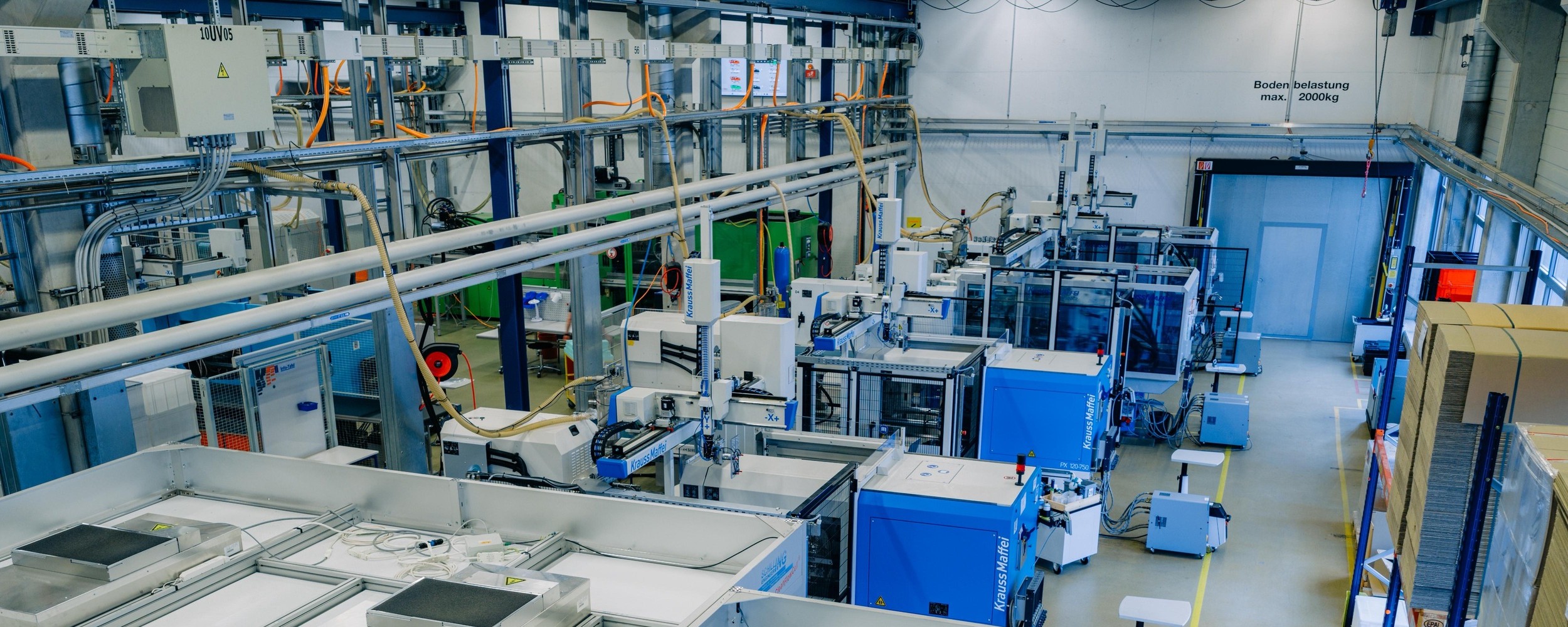
Polypropylene can be processed cost-effectively and consistently using injection molding. The material is characterized by good flow properties, which makes it possible to produce even complex geometries or thin-walled structures. At the same time, the semi-crystalline material structure requires carefully controlled processing to reliably achieve dimensional accuracy, surface quality, and mechanical properties.
Unlike hygroscopic plastics, polypropylene generally does not need to be pre-dried. Under certain conditions, such as improper storage or when using filled materials, drying may still be advisable to prevent surface defects or process fluctuations. The specific processing parameters are therefore always determined based on the type of material used and the quality requirements of the component.
What are the typical processing temperatures for PP?
The processing temperature in PP injection molding depends on the material used, the part geometry, and the mold design. Typical melt temperatures are often in the range of approximately 190 to 250 °C. Filled or reinforced polypropylene grades may require higher processing temperatures. The mold temperature is typically kept within a moderate range to achieve sufficient surface quality and a stable cycle time.
However, it does not make sense to set a fixed processing temperature for PP injection molding. What is crucial is a tailored process window that takes into account the following factors, among others:
- Material Type and Compounding
- Wall thicknesses and component geometry
- Surface finish and dimensional accuracyrequirements
- Tool design and cooling concept
- Production volume and cycle time
Structured process development makes it possible to take these factors into account at an early stage and establish stable production processes.
What process factors influence component quality?
In addition to the processing temperature, other parameters also influence the quality of polypropylene injection-molded parts. These include, in particular, injection speed, holding pressure, cooling time, and mold temperature control. Carefully coordinated process control helps minimize typical defects such as warpage, sink marks, or flash.
The shrinkage behavior of polypropylene also plays an important role in process design. Its semi-crystalline structure results in a characteristic change in volume during the cooling phase. Through appropriate mold design, optimized process parameters, and the selection of suitable materials, the dimensional stability of production parts can be specifically controlled.
Component Design for PP Injection-Molded Parts
A material-appropriate component design is a key factor in the cost-effective and consistent production of polypropylene injection-molded parts. Due to its semi-crystalline structure, polypropylene exhibits significant shrinkage. Therefore, as early as the initial development phase, geometry, wall thicknesses, and functional requirements should be tailored to the material to prevent warping, sink marks, or dimensional deviations.
A uniform wall thickness distribution contributes significantly to stable process control. Significant variations in wall thickness can lead to uneven cooling and, consequently, warping or internal stresses. Where necessary for the design, ribs or reinforcement structures can be used to increase stiffness without increasing wall thickness. This approach supports both part quality and efficient cycle times.
Draft angles also play an important role in polypropylene injection molding. Due to its semi-crystalline structure, polypropylene tends to adhere more strongly to the mold than amorphous plastics. Adequate draft angles facilitate the safe removal of parts and help protect the mold.
Other factors that should be taken into account in component design include:
- Ribs to increase stiffness while minimizing material usage
- Radii to prevent stress peaks
- Consistent wall thicknesses to minimize warping
- Functional integration to reduce assembly effort
- Sprue locations to ensure uniform filling
Early coordination between design, material selection, and tooling concepts makes it possible to take these factors into account as early as the development phase. This helps reduce technical risks and establish stable production processes for polypropylene injection molding.
Surfaces and Finishing
The surface quality of polypropylene injection-molded parts is primarily determined by the mold surface, process control, and material selection. Polypropylene allows for both technical functional surfaces and textured or visually defined component surfaces. Depending on the requirements, matte, textured, or slightly glossy surfaces can be achieved. Among other factors, mold temperature, injection parameters, and cooling conditions influence the final appearance of the components.
Downstream processing steps can be integrated depending on project requirements. These include, for example, assembly processes, ultrasonic welding, laser marking, or packaging steps. Integrating these processes into the production line ensures reproducible results and efficient production workflows in polypropylene injection molding.