

Thermoplastic injection molding
Thermoplastic injection molding is one of Mythentec's core manufacturing technologies. The combination of a broad-based materials portfolio, modern fully electric systems, and a structured quality environment enables reproducible series processes for technical components, functional components, and precision applications. This creates a reliable framework for customers: from the initial material decision and tool design to validated series production under regulated conditions.
SERVICES PROFILE
- 15 injection molding machines
- Single- and two-component technology
- Clamping force from 50t to 420t
- Part weight from 0.01 g to 1 kg
- Fully automated with 3-axis and 6-axis robots
- Digitized by Leitrechnersystem:
– IST parameter recording
– Batch tracking
– Planning and monitoring - Production in ISO 7 and ISO 8 clean rooms in accordance with EN ISO 14644
- Qualified injection molding machines and validated processes
- Processing of high-performance plastics
- Processing environmentally friendly "plastics"
- Tool storage in separate fire compartment


Thermoplastic injection molding at a glance
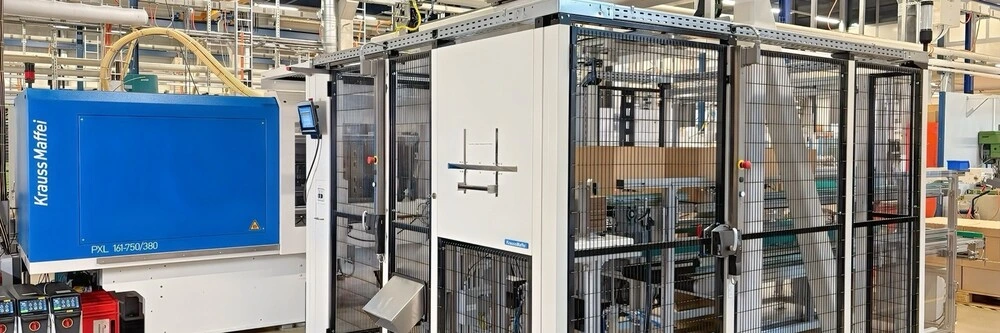
Thermoplastic injection molding is a cyclical process in which plastic granulate is melted, injected into a mold under controlled pressure, and then demolded after cooling. The uncrosslinked structure of thermoplastics allows this repeated softening and solidification, which offers a significant advantage for economical series production and for components with complex geometries.
The process is divided into a few clearly defined steps:
Plasticizing the melt,
Injecting into the mold,
Holding pressure and cooling phase
Subsequent demolding
Parameters such as melt temperature, mold temperature, injection and holding pressure profile, and cavity venting determine the dimensional accuracy and stability of the components produced. Precisely controlled process data allows the quality to be documented in a traceable manner in every phase of series production.
Thermoplastic injection molding is suitable for a wide range of applications: from standard parts with moderate requirements to components that are mechanically, thermally, or regulatory demanding. Mythentec uses these processes to enable functional integration during injection molding, for example by mapping snap hooks, sealing lips, or through 2-component solutions in combination with thermoplastic elastomers. If necessary, production can take place under clean room conditions in accordance with ISO classes 7 or 8, for example for applications in medical technology or diagnostics.
material expertise
The choice of the right thermoplastic has a decisive influence on how reliably a component will perform its function in the long term. Mythentec combines many years of processing experience with a wide selection of standard, technical, and high-performance thermoplastics. This allows requirements such as temperature resistance, media resistance, transparency, elasticity, strength, or haptics to be specifically matched in the early project phase.
For customers, this means a material-appropriate design from the very first draft: wall thicknesses, flow paths, demolding concepts, and possible 2K combinations are tailored to the properties of the respective plastic.
Standard thermoplastics for economical series solutions
Typical materials:
- PS (polystyrene): easy to mold, for simple housings and visible parts
- PMMA (acrylic glass): high transparency, suitable for optical covers
- PETG: good impact resistance, clear components with low processing requirements
Technical thermoplastics for resilient functional parts
Engineering thermoplastics cover a wide range of requirements. They combine good mechanical properties with increased temperature and media resistance, making them suitable for many technical assemblies.
Typical materials:
Polyamides (PA): from PA 6 to PA 6.6, PA 12, PA 4.6, PA 9T, and other special types
POM (acetal): high dimensional stability, low friction, suitable for precision functional parts
PC (polycarbonate): impact-resistant, transparent or filled, often used for protective covers
PBT / PET: good media and heat resistance, technical housings
ABS / ASA / SAN: stable all-round materials with adaptation options for outdoor conditions
Typical applications:
Mechanically stressed components with tight dimensional stability
Components exposed to media such as grease, cleaning agents, or moisture
Functional parts in equipment and plant engineering
High-performance thermoplastics for extreme requirements
High-performance thermoplastics are used wherever high continuous operating temperatures, aggressive media, or safety-critical functions occur. They enable series production processes for components that would otherwise only be manufacturable with special materials or multi-step processes.
Typical materials:
PEEK / PEK
PPS
PEI
PSU / PES
PI
PPO
Typical characteristics:
Temperature resistance often > 150 °C
Very high chemical stability
Low-shrinkage, dimensionally stable components with a long service life
Areas of application:
Medical components
High-temperature environments
Functional components with strict performance requirements
Thermoplastic elastomers and multi-component solutions
Thermoplastic elastomers (TPE) combine elastic properties with thermoplastic processing. They are ideal for flexible seals, soft-touch areas, or components with local elasticity. In combination with a hard base material, functionally optimized components can be produced using 2K injection molding.
Typical materials:
TPE-S, TPE-O, TPE-V
TPE-E
TPE-U (TPU)
TPE-A (PEBA)
Examples of use:
Soft components in grip elements
Sealing and connecting elements
Multi-component solutions for functional integration
Injection molding process: from concept to series production
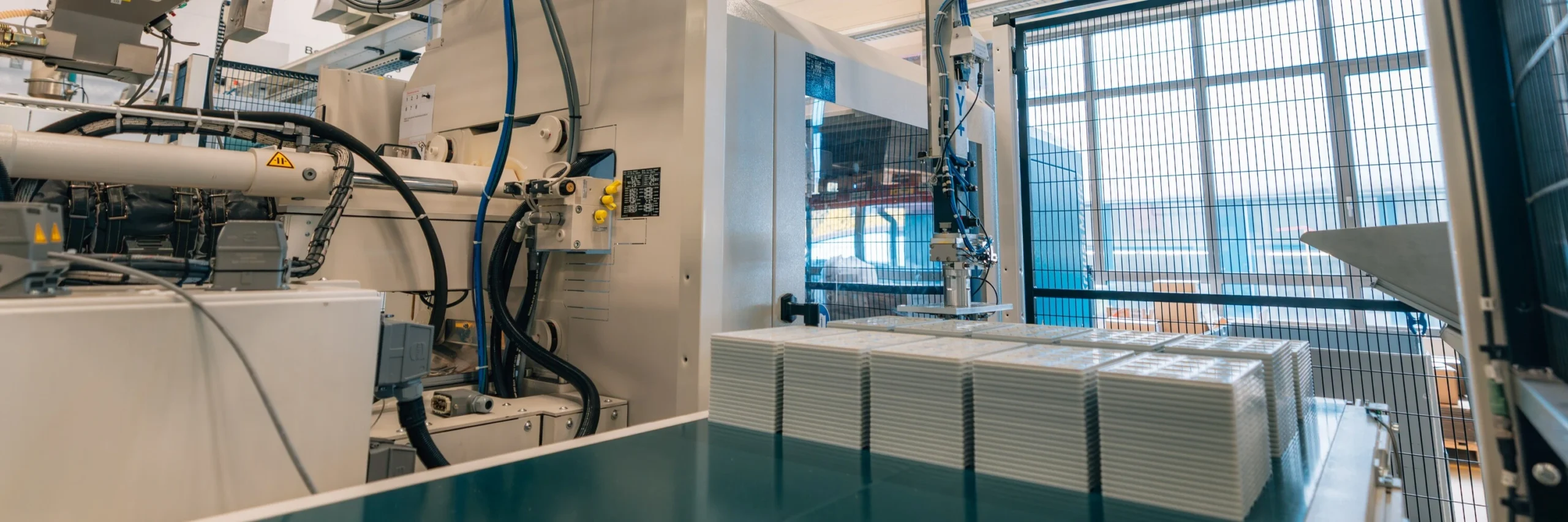
A stable and reproducible injection molding process is the result of the interplay between design, precise implementation, and structured quality management. Mythentec therefore supports projects throughout the entire product life cycle. Materials properties, component geometry, and process-relevant parameters are evaluated jointly at an early stage in order to minimize risks in a targeted manner. During series production, digital process data, fully electric machines, and automated processes ensure consistently high quality.
The design forms the basis for stable production processes. It includes optimizing the design in terms of flow behavior, venting, mold separation, and demolding mechanisms, as well as selecting the appropriate thermoplastic. Differences in shrinkage, thermal conductivity, or toughness of the materials determine how wall thicknesses, radii, injection points, or cooling channels are designed. If necessary, the expected filling and warping behavior is simulated in order to identify critical areas at an early stage and develop a tool that reliably reproduces the component geometry in later series production.
Once the mold is ready, the actual production phase begins. Here, the melt and mold temperatures, injection and holding pressure profiles, and cooling times are set to suit the selected thermoplastic perfectly. Fully electric injection molding machines enable precise parameter control, while 3- and 6-axis robots ensure reproducible processes for removal and handling. All relevant process data—from pressure profiles to mold temperature—is digitally recorded and linked to ERP and host computer systems. This allows all batches to be traced, and deviations can be detected and corrected at an early stage, which is particularly important for applications in regulated industries.
After injection molding, Mythentec takes on additional value-added steps that can be seamlessly integrated into the production process. These include ultrasonic welding for permanent connections of plastic components or laser marking for identification, function, or quality assurance. Assembly work—manual, semi-automatic, or fully automated—is also integrated directly into the line. In addition, components can be cleaned, conditioned, or tested and then delivered in customer-specific packaging units. This integrated process chain reduces interfaces and facilitates planning along the entire supply chain.
Quality and validation
Mythentec combines modern production technology with structured quality management geared towards stable series processes and complete traceability. This is based on certified management systems, comprehensive process documentation and, if required, production under controlled clean room conditions. This means that even projects with regulatory requirements can be reliably implemented, for example in medical technology or for safety-critical components.
Quality assurance begins as early as the development phase. Material batches, machine parameters, and test characteristics are documented in a traceable manner so that all steps from initial sampling to ongoing series production remain transparent. In addition, the digital production environment supports the evaluation of process data and enables seamless tracking of each batch.
certifications
Mythentec works on the basis of ISO 9001 & ISO 13485 and thus fulfills both general requirements for quality management systems and industry-specific specifications for the manufacture of components in the medical technology environment. These standards define clear processes, test points, and responsibilities that are integrated into the entire manufacturing process.
Working with Mythentec: from initial consultation to series production
At Mythentec, successful collaboration begins with a careful analysis of requirements. Functional objectives, environmental conditions, regulatory requirements, and desired materials are recorded during the initial consultation. This forms the basis for a clear project framework that defines which materials are suitable, how the component can be optimized in terms of design, and which injection molding process offers the greatest benefits. This early exchange helps to shorten development time and avoid subsequent adjustments.
During project planning, the tool concept, schedule, and quality criteria are agreed upon jointly. Mythentec coordinates with toolmaking partners, plans validation and sampling steps, and ensures that material batches, process parameters, and test characteristics are documented transparently. As soon as the tool is available, the process is set up, tested, and approved for series production.
The subsequent industrial implementation encompasses complete series production, including process monitoring, further processing, assembly, and customer-specific packaging.
Interested?